
At the speed of right
We set a rather audacious goal at Breaking News to solve a hard problem, and it’s best explained with an example.
Let’s say you just traveled to a foreign country and checked into your hotel. Moments later, a loud explosion shakes the building. You look out the window and see a column of smoke of few blocks away. Was it an accident? Or an attack of some kind?

File photo of a helicopter crash in London, January 16, 2013. AP Photo / Victor Jimenez
You have an intense need to know what happened. The longer you have to wait without good information, the higher your anxiety level — and the potential risk surrounding you.
This is information lag: the delay between something important happening and you learning about it. The more important it is to you, the more urgently you need to know.
Our goal is to collapse that delay as close to zero as possible, enabling you to make smarter, safer decisions in real time, wherever you are.
Approaching Perfect Knowledge
The more connected the world becomes, the more we can chip away at information lag. The fastest sources of information are social media and a growing army of sensors and live video streams.
“We’re heading towards a world of perfect knowledge,” explains Peter Diamandis, Chairman and CEO of the X PRIZE. “Soon you’ll be able to know anything you want, anytime, anywhere.”
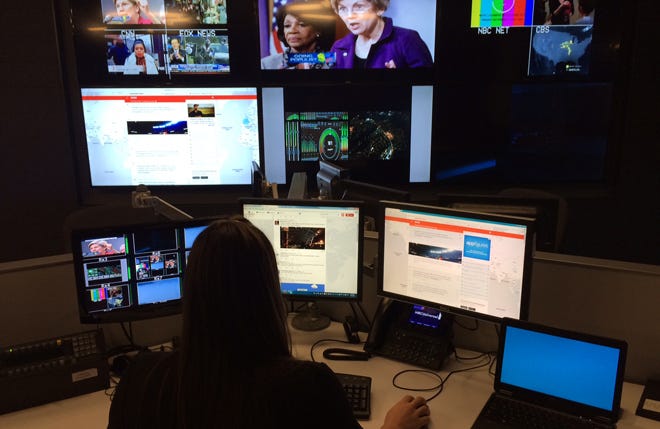
Breaking News’ Stephanie Clary monitors the world.
Implicit in the idea of perfect knowledge is reliability. If the information is wrong or misleading, it creates more harm than the delay itself. Our challenge is to operate at the speed of right, achieving both in parallel.
This may be counter-intuitive for some journalists who believe speed and right are mutually exclusive. While we have a ways to go, we’ve made great progress with innovations like proximity alerts, nearby news, editor’s notes and our unique approach to live video. And we have several more to come.
The Value of Knowing Faster
The faster you find out about a breaking story that’s uniquely important to you, the more utility you derive from it. If you’re a stock trader, that’s an obvious statement. But it also applies to news on a wider scale.
I remember when we were testing proximity alerts in the Breaking News app last year, and I received a notification about a shooting on Seattle Pacific University’s campus, about three miles away from my location.

That brick building on the right is the daycare. Photo by KCPQ’s David Rose.
It took a moment to register, but I realized that my two kids were attending daycare right across the street from campus. I instinctively called my wife, and she called the daycare.
She was the first parent to call. The officer manager calmly told her the building was in lockdown and police officers were stationed outside. Everything was under control.
It didn’t take long for the daycare’s phone to jam with dozens of anxious parents dialing over and over. The gunman shot three people on campus before he was caught, and TV stations were now in wall-to-wall coverage. Stretchers were lined up outside the daycare.
But we knew our kids were safe.
Finding You When it Matters Most
In the new mobile world, push — relevant content that comes to you — is gaining traction over pull. I was oblivious about the shooting until I received a proximity alert in the form of a push notification, reducing the information lag on a story that was extremely important to me.
By receiving that alert, I had a higher expectation that the story was real. It’s not the same as scanning a social media post. Push elevates urgency, especially when it’s targeted to you. That’s why we have an editorial team working around the clock, vetting stories in real time.
Sending the same thing to everyone is easy, but pushing exactly what people want and need — even if they didn’t specifically tell you — is a challenge when you’re operating at the speed of right. But the end result is powerful and potentially life-saving. It’s not just-another-news-app with a nice design, but an indispensable information lifeline.
Come Help Us at Breaking News
From editorial to technology, we architected our entire company around being the fastest, most reliable source of breaking news on the planet. Our obsession with information utility — reducing information lag so people can make smarter, safer decisions — is a different approach than other news startups. We focus on time saved, not time spent.

Breaking News’ Jillian Stampher snaps a photo of the view from our Seattle HQ.
That’s why we continue to grow a highly influential and deeply loyal audience. We’re also expanding our team. Breaking News is looking for smart product and editorial talent who love to move fast, challenge convention and share our unique obsession. If you’re interested in learning more, please drop me a note over Twitter or email me at cory [dot] bergman [at] breakingnews.com.
(Breaking Newsis a standalone startup owned by NBCUniversal with offices in Seattle, New York and London. We make our own editorial and product decisions with the backing of a big media company. There’s no other startup like us, and we hope to hear from you.)